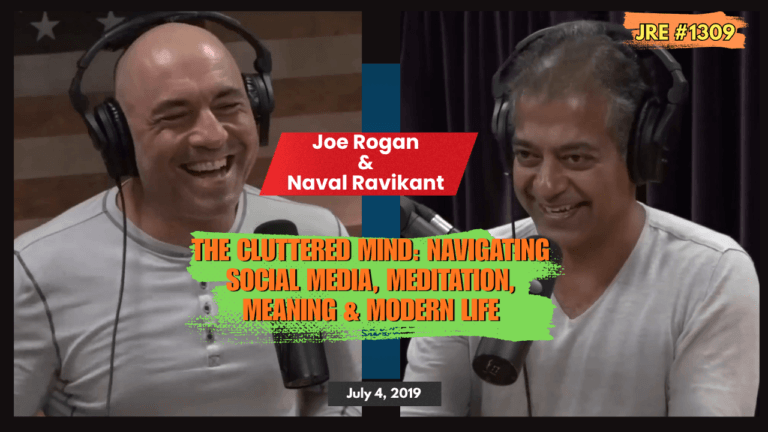
🎙️ JRE #1309 | 📅 Spotify Release Date: Jul 4, 2019
Image Credit: Screenshot of JRE #1309
The JRE #1309, features a comprehensive conversation with Naval Ravikant, an influential investor, entrepreneur, and thinker, who shares his philosophy on life, wealth, happiness, technology, personal growth and society. Naval Ravikant shares powerful insights on wealth, happiness, mindset, and the future of work—challenging conventional ideas about success and fulfillment.
From escaping the 9–5 to mastering your thoughts, these ideas offer a practical framework for living with more freedom and purpose.
Naval Ravikant Reading Habit
Naval Ravikant describes a non-linear reading style shaped by growing up in a library, where curiosity—not completion—drives what and how he reads. He rejects the idea of finishing many books as a status symbol, instead preferring to revisit a smaller set of valuable ideas until they’re deeply understood.
In an age of information overload, Naval embrace jumping between multiple sources as a way to quickly explore and connect ideas rather than reading sequentially.
Social Media And Celebrity Status
Joe Rogan and Naval Ravikant explore how social media encourages people to curate idealized versions of their lives, turning identity into performance and making self-worth dependent on others’ perceptions. This creates fragile self-images—built on praise but easily damaged by criticism—while also exposing people to the downsides of visibility, where attention often overrides personal boundaries.
Naval suggests that true success lies not in fame but in achieving wealth, health, and happiness—ideally while remaining grounded, anonymous, and internally stable.
Social Contract
Naval explains that happiness can be cultivated as a conscious choice, reinforced by publicly committing to it, since people tend to stay consistent with what they declare to others. He presents desire as a source of unhappiness—encouraging focus on a few meaningful goals while letting go of trivial wants to maintain calm and clarity.
A calm and controlled mind tends to produce better decisions and stronger performance, making inner peace not just desirable but practical.
Working For Yourself
Naval anticipates that the information age will dismantle the industrial-era model of large hierarchical companies, reverting work to a hunter-gatherer-like structure where individuals operate independently or in small, flexible teams. Advances in technology—like gig platforms, easy payments, and remote communication—are lowering transaction costs, enabling high-quality gig work where people select projects on their terms, get paid instantly, and take breaks as needed.
Smaller firms or solo operations foster greater happiness, creativity, and humanity compared to rigid corporate environments.
Universal Basic Income
Universal Basic Income (UBI) is presented as a fix for job losses from automation, but Naval views it as a misguided response to a non-issue, noting that technological advances—like electricity or factories—have always displaced old jobs while creating better, unforeseen ones such as podcasters or gamers. With record-low unemployment, the real challenge is the speed of retraining for new roles, not a finite job shortage.
UBI, in his view, risks encouraging dependency, straining economies, discouraging entrepreneurship, and weakening self-reliance.
General AI
Naval downplays fears of AI automating serious programming, arguing that coding is fundamentally structured thinking, and an AI capable of matching it would imply world-dominating general intelligence—which remains far away. Current AI systems are narrow tools focused on pattern recognition, lacking creativity and deep understanding.
True general AI would require breakthroughs in understanding biological intelligence and real-world learning, leaving human creativity as a lasting advantage.
Socialism And Capitalism
Naval argues again that Universal Basic Income (UBI) creates a slippery slope to socialism by incentivizing voters to demand ever-higher handouts, ultimately bankrupting economies, and dismisses it in favor of retraining programs to adapt to job shifts. Capitalism, rooted in free exchange and positive-sum value creation, faces valid critiques like cronyism and monopolies but outperforms socialism, which relies on violence for equal outcomes and has failed catastrophically wherever tried.
Sustainable progress, in this view, comes from equal opportunity rather than enforced equality of outcomes.
Virtue Signaling
Naval criticizes “privilege” discourse as performative signaling that often targets the wrong groups while ignoring deeper issues. Social media amplifies this behavior, encouraging exaggerated moral positioning rather than meaningful action.
Parody accounts like Tatiana McGregor expose the absurdity by amplifying leftist clichés to extremes, revealing hypocrisy and the true power holders as those beyond criticism.
Internet, News And Social Media
Naval reasons that social media’s broadcasting power is a net positive for exposing injustices instantly but currently fuels context-free mob outrage, turning snippets into viral attacks that society must learn to dismiss as low-IQ foot soldier tactics. Constant exposure to news and digital stimuli overwhelms the mind, reducing clarity and increasing anxiety.
The modern individual’s core struggle is resisting weaponized addictions from capitalism (sugar, drugs, porn, games, social feeds) alone, by setting personal boundaries.
Silicon Valley Left Leaning
Joe Rogan condemns media outlets for doxxing an ordinary Trump-supporting day laborer over a parody video slowing Nancy Pelosi, enabled by Facebook handing over his data, signaling social platforms’ self-destructive censorship slide. Naval observes that traditional journalism has commoditized into tribal propaganda machines.
Naval warns that tech companies wield significant influence over public discourse, shaping narratives while also risking backlash and decentralization.
Technology, Power, and the Leftward Drift of Institutions
Naval argues that technological progress tends to push societies politically left by empowering individuals, weakening traditional institutions like family and religion, and increasing reliance on centralized systems. Universities, once grounded in the credibility of hard sciences, are described as increasingly dominated by politicized social sciences, leading to conflicts with empirical disciplines like biology.
This tension, combined with social pressure and ideological conformity, is believed to be limiting open scientific inquiry and distorting debates on key issues such as gender, human behavior, and climate science.
Left Vs Right
Joe and Naval highlights how topics like climate science, gun control, and immigration getting politicized with people talking past each other—debating different issues (e.g., tyranny vs. school shootings, illegal vs. legal borders)—with no room for nuance amid tribal loyalties. Naval suggest a good system, like censorship or immigration policy, should withstand enemies running it for a decade, yet first-past-the-post voting forces beliefs into rigid Democrat/Republican bundles, punishing independent thought.
Politics muddles clear thinking by socializing beliefs through tribal signaling, so avoiding it preserves mental clarity.
The Art Of Doing Nothing
Naval emphasises that modern life’s biggest challenges come from overabundance—of information, stimulation, and entertainment—rather than scarcity, leading to mental overload and distraction. Naval advocate for solitude and meditation, emphasizing the importance of learning to sit with one’s thoughts and process unresolved mental “noise.”
Over time, the ability to be alone and mentally at ease becomes a powerful tool for clarity, self-awareness, and well-being.
Be The Change In Environmental Movement
Joe and Naval argues that meaningful change starts with personal action rather than trying to force others to change, as leading by example is far more impactful than social media outrage. Using environmentalism as an example, they suggest that real progress comes from practical solutions—like innovation and incentives—rather than moral pressure or calls to halt growth.
Ultimately, lasting change happens when better alternatives are made accessible and desirable, aligning human behavior with progress instead of resisting it.
Meaning Of Life
Naval explains that the question of life’s meaning has no definitive answer, as any explanation ultimately leads to infinite regress, circular reasoning, or arbitrary assumptions. Instead of searching for a universal truth, individuals are free to create their own meaning, which is what gives life its flexibility and richness.
The process of exploring the question itself brings insight, perspective, and a sense of peace.
Freedom From Money Problem
Naval defines true wealth as freedom—specifically, the ability to stop sacrificing today for a future payoff and instead live fully in the present. This can be achieved by lowering expenses, building passive income, or doing work so meaningful it no longer feels like work.
The path to true financial freedom lies in developing unique skills, staying authentic, avoiding lifestyle inflation, and creating value that society rewards.
Victim Mentality
Joe Rogan warns that saying “it’s easy for you” is a mental trap that reinforces a victim mindset and prevents personal growth, emphasizing that success and happiness require effort and responsibility. Naval shares his gritty upbringing—from washing dishes and mowing lawns as a kid to scraping together $400 for college—proving wealth-building is brutally hard yet rewarding, forging meaning through sacrifice rather than handouts.
Over time, happiness develops through intentional mindset shifts, reduced desires, and a focus on positive interpretation.
Bonus Shorts
In the Shorts below:
1. AI and Creative Thinking
2. More Time Spent On Internet
3. Modern Struggle
4. Silicon Valley and Political Identity
5. Power of Social Media
6. Technology Leans Left
7. Test of a Good System
8. Modern Life – Disease of Abundance
9. Agrippa’s Trilemma
10. Create your Own Meaning
11. True Learning
12. No Happiness in Material Possession
Want to take a deeper look at the principles of Naval Ravikant and his advice further? The Almanack of Naval Ravikant compiles his strategies for wealth, happiness, and thoughtful living
(This is an affiliate link, which means I may earn a small commission at no extra cost to you.)

The Almanack of Naval Ravikant: A Guide to Wealth and Happiness
by Eric Jorgenson
The Almanack of Naval Ravikant: A Guide to Wealth and Happiness is a compilation of wisdom and life philosophy from Naval Ravikant — not a traditional narrative story, but a curated guide on how to build lasting wealth and cultivate deep personal happiness. It was put together by Eric Jorgenson from Naval’s interviews, tweets, podcasts, and writings, organized into a practical, readable format.
As an Affiliate Associate, I earn from qualifying purchases.
About the Author:
Naval Ravikant is an entrepreneur, angel investor, and philosopher known for founding AngelList and sharing insights on startups, wealth, and personal growth.
Enjoyed this content? Help power future podcast clips (and my caffeine levels) ☕
☕ Buy Me a CoffeeEvery coffee helps keep the content coming!
Disclaimer: This content is provided for informational and entertainment purposes only. Views expressed in the embedded video or original podcast belong to the respective creators and do not necessarily reflect the views of this website. No affiliation or endorsement is implied.