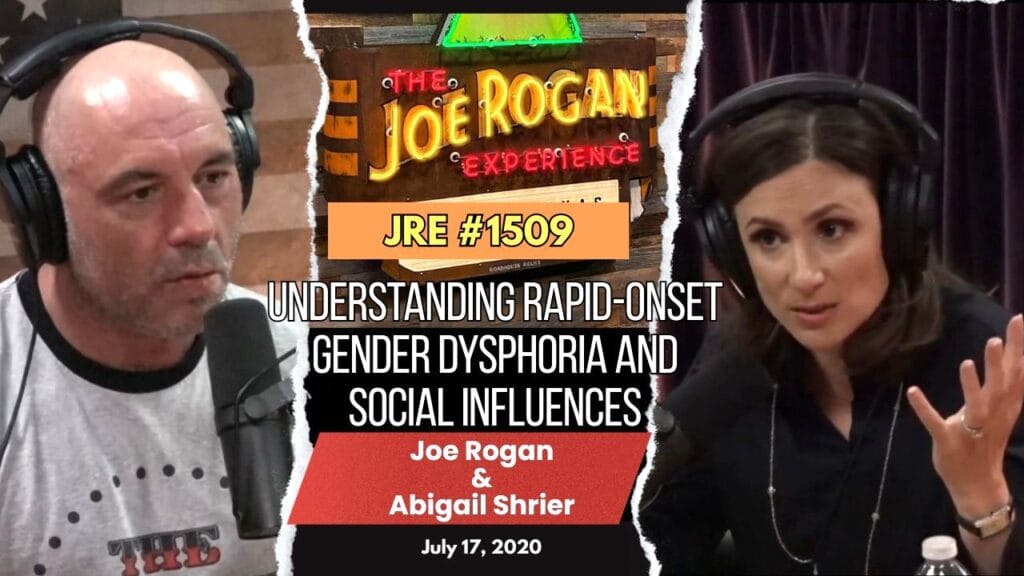
🎙️ JRE #1509 | 📅 Release Date: July 17, 2020
Image Credit: Screenshot of JRE #1509
In this episode of the JRE #1509, author Abigail Shrier discusses her research into a sudden surge of gender dysphoria among teenage girls, a demographic she argues was previously unaffected by the condition. She differentiates between long-term transgender adults, whom she supports, and adolescents she believes are influenced by social media and peer groups.
Shrier characterises this trend as a social contagion driven by online influencers and “affirmative care” models that bypass traditional mental health oversight. The conversation highlights concerns regarding medical interventions, such as testosterone and surgery, which Shrier claims are being accessed by minors without adequate scrutiny.
Ultimately, she warns that this phenomenon causes irreparable physical damage to vulnerable young women who may later regret their decisions.
01- Adolescent Girls and the Rise in Gender Transition
The speakers discuss the rise in teenage girls identifying as transgender, suggesting that many are socially isolated, anxious, and struggling with underlying mental health issues, and may interpret their distress as gender dysphoria influenced by peer groups and social media. Citing a study by Lisa Littman, they argue that cases appear highly clustered within friend groups rather than randomly distributed, challenging the idea that increased acceptance alone explains the trend. They also question why older women are not coming out in similar numbers and express concern about rising suicide rates and the broader teen mental health crisis, linking these issues to social media influence.
02-Social Media, Transition, and the Debate Over Teenage Girls’ Mental Health
The speakers argue that rising anxiety and depression among teenage girls—linked to social media and discussed in The Coddling of the American Mind by Jonathan Haidt—may be contributing to an increase in girls identifying as transgender. Drawing on research by Lisa Littman and interviews with parents and detransitioners, they claim that for some teens, medical transition does not resolve underlying mental health struggles and may instead lead to irreversible decisions made through self-diagnosis and informed consent pathways, including access to hormones and surgery through providers like Planned Parenthood. The conversation questions whether social affirmation and framing the issue as a civil rights matter may discourage scrutiny, while emphasizing concerns about long-term psychological and physical consequences for vulnerable adolescents.
03-Validation Culture and the Influence of Online Affirmation
The speakers explore how social media validation and public celebration may influence vulnerable teenage girls to adopt identities that bring them praise and belonging. They argue that affirmation—likes, supportive comments, and online communities—can create a powerful feedback loop, particularly for lonely or struggling teens, reinforcing identity decisions in ways that may not allow space for reflection. The conversation also highlights how filtered images, celebrity culture, and online comparison intensify insecurity among girls, making them especially susceptible to social contagion and external validation.
04-Peer Contagion and Teenage Girls’ Mental Health / How Social Influence Shapes Adolescent Behavior / Are Mental Health Trends Socially Contagious?
The speakers discuss the idea of “social contagion,” arguing that certain mental health struggles—such as anorexia, self-harm, and trans identification—can spread within peer groups, particularly among teenage girls who are described as highly empathetic and prone to absorbing their friends’ distress. They contrast this with boys, who they suggest are more likely to externalize struggles through activity or competition rather than emotional mirroring. The broader point is that adolescent behavior—both positive and negative—can be strongly shaped by peer reinforcement, social acceptance, and group dynamics.
05-Online Discourse, Teen Vulnerability, and the Influence of Influencers / 4. Why Social Media May Be Harming Teen Mental Health
The speakers argue that anonymous online commentary amplifies negativity because people process hostile remarks from strangers similarly to criticism from trusted peers, making social media psychologically damaging—especially for adolescents. They contend that public humiliation, influencer culture, and online affirmation loops intensify teen mental health struggles, particularly among girls. The discussion also raises concerns about transgender influencers promoting testosterone as a solution to distress, highlighting its short-term mood effects alongside potential long-term medical risks, while contrasting this trend with the historically early-childhood presentation of gender dysphoria.
06-Early Gender Dysphoria vs. Socially Influenced Identity
The speakers discuss how to distinguish between children with longstanding gender dysphoria and teenagers who may be influenced by peers or social trends. They argue that historically, gender dysphoria typically appeared in early childhood—often in boys—and many children eventually grew out of it, sometimes later identifying as gay adults. The conversation raises concerns about adolescents making life-altering medical decisions, such as hormone treatments, under informed consent policies introduced by organizations like World Professional Association for Transgender Health, questioning whether teenagers are developmentally prepared to choose interventions with uncertain long-term effects.
07-Children, Hormone Blockers, and the Affirmative Care Debate
The speakers debate medical transition for children and teenagers, questioning whether minors are equipped to make irreversible decisions about hormones and surgery without extensive psychological evaluation. They argue that “affirmative care,” endorsed by major medical bodies and shaped by policies from groups like the World Professional Association for Transgender Health and the American Medical Association, prioritizes validating a young person’s self-diagnosis, sometimes under informed consent models that require limited oversight. The conversation raises concerns about long-term effects, the role of conversion therapy bans, and whether a rapid rise in adolescent transitions—particularly among teenage girls—reflects improved recognition or a broader social and medical shift happening across Western countries.
08-A Sudden Surge: What’s Behind the Rise in Teen Trans Identification?
The speakers highlight what they describe as a dramatic increase in transgender identification among high school students, rising from historically rare diagnoses of gender dysphoria (around 0.01% of the population) to roughly 2% of U.S. high schoolers, with teenage girls reportedly making up the fastest-growing group. They reference data from countries like the UK, where centralized health systems have recorded sharp increases in adolescent female referrals, and argue that easier access to medical transition without formal diagnoses complicates tracking in the U.S. The conversation frames the issue as controversial and difficult to discuss publicly, with concerns about social influence, institutional affirmation policies, and professional risks for clinicians who question adolescent self-diagnosis.
09-Gender Identity and Female Athletics: Where Should the Line Be Drawn?
The speakers argue that while many transgender adults simply want to live peacefully and be respected, current policies around inclusion in women’s sports and female-only spaces can create conflicts, particularly because biological differences after male puberty may affect athletic fairness and safety. They reference examples such as high school track competitions in Connecticut, mixed martial arts fighter Fallon Fox, and backlash against Martina Navratilova to illustrate what they see as a broader cultural clash between affirming gender identity and maintaining sex-based categories in sport.
10-Activism Vs. The Rights Of Biological Women
The speakers argue that some lesbians feel marginalized within LGBTQ spaces due to conflicts over gender identity and the inclusion of trans women, and they describe “TERF” (originally a derogatory label for women defending female-only spaces) as a label applied to feminists who prioritize sex-based rights. They suggest that social media intensifies backlash and suppresses open debate, particularly for parents and professionals who question aspects of youth gender transition. Overall, they call for more nuanced, open discussion of psychological and medical risks before adolescents pursue irreversible treatments.
The transcript discusses how many lesbians feel culturally marginalized and have formed underground social groups with strict vetting processes to prevent infiltration by trans activists, particularly those perceived as biological males insisting they are lesbians and bringing aggressive or dominating behaviors into women-only spaces. It critiques the term “TERF” (originally a derogatory label for women defending female-only spaces) and highlights shifts in language around trans identities, noting that earlier generations of trans people were more open about their biology, while current pressures from social media and fear of backlash force conformity to phrases like “trans women are women.” The speakers argue that social media suppresses open discussion and dissent—leading to adjusted beliefs, career risks, and parental hesitation in challenging children’s gender transitions—while transgender medicine conferences celebrate without addressing risks, contrasting with rigorous debates in other medical fields.
11-Parents, Puberty Blockers, and the Debate Over Informed Consent
The speakers discuss youth gender transition and argue that most parents who pursue medical interventions for their children believe they are acting out of love and fear, often influenced by professionals warning of severe mental health risks if they do not affirm transition. They express concern that some parents may not be fully informed about potential long-term consequences of puberty blockers and cross-sex hormones, including impacts on sexual development and fertility. The broader theme is a call for more transparent discussion of medical risks and greater caution in determining whether a child’s gender distress is persistent before pursuing irreversible treatments.
12-Erasing Female Athletic Achievements And Records
The speakers argue that allowing transgender women who experienced male puberty to compete in women’s sports undermines fairness and discourages female athletes, claiming that biological differences in strength and performance erase opportunities and achievements for women. They suggest that social and institutional pressure discourages open discussion of these concerns, with critics facing backlash for dissenting from progressive norms. Overall, they frame the issue as a broader cultural conflict between inclusion and the preservation of sex-based protections established under policies like Title IX.
13-Backlash, Cancel Culture, And Publishing Challenges
The speaker reflects on the backlash she has faced for writing her book but maintains that it documents what she believes is a real and urgent mental health phenomenon affecting teenage girls, arguing that the issue would have surfaced regardless of who reported on it. She emphasizes that many distressed parents contact her seeking guidance, often expressing regret and confusion about medical decisions made under social and professional pressure. The discussion frames youth gender transition as potentially influenced by social contagion dynamics, comparing it to past trends like cutting or suicide clusters, and calls for greater psychological support and open inquiry rather than stigma or suppression of debate.
14-Gender Ideology In School Curriculums
The speaker argues that schools are spending insufficient time teaching children about psychology and self-understanding, leaving them vulnerable to outside influences, including early exposure to gender ideology. She criticizes curricula in places like California that present concepts such as “a boy’s brain in a girl’s body” as fact, framing it as indoctrination rather than education, and emphasizes the lack of parental oversight. While acknowledging that science on transgender brain differences is still evolving, she stresses that these lessons can influence vulnerable youth, and she underscores the importance of protecting spaces like sports where biological differences matter.
15-Suppressing Data On Detransition And Regret / Debating Transition, Regret, and Activism
The speaker highlights the difficulties in studying detransitioners, noting that social media and activist pressure have skewed or undermined research, making it hard to understand the experiences of those who regret transitioning. She emphasizes that gender identity is complex and varied, with some people experiencing genuine dysphoria while others are influenced by social and cultural factors, and stresses the need for open, nuanced scientific inquiry. While acknowledging social sensitivities, she argues that avoiding discussion harms both teenagers and adults by preventing understanding and informed decision-making.
A researcher’s study on teenage female detransitioners was sabotaged by online activists who coordinated to skew survey results, making it harder to understand how common regret after transition really is. The speakers argue that detransitioners’ experiences should be openly studied and discussed, emphasizing that different people have different causes for their dysphoria and that anecdotal stories do not invalidate the needs of genuinely gender dysphoric individuals. They criticize an activist culture that treats any questioning of youth transition as hate, pressures children to see themselves as prophets of their own identity, and uses aggressive tactics that, in their view, harm both scientific inquiry and public perception of trans people.
Bonus Shorts
In the Shorts below:
1. Erectile Dysfunction Under 40 years
2. BPA, BPF and BPS Bottles
3. Do not Microwave in Plastic
4. Drawback of Phthalates in men and women
5. Identifying safe plastics
6. US and Europe regulation standard
If you found this conversation interesting, you might enjoy exploring the ideas further in Abigail Shrier’s book below.
(This is an affiliate link, which means I may earn a small commission at no extra cost to you.)

Irreversible Damage
by Abigail Shrier
The book explores how social and cultural influences, particularly online and peer environments, are driving adolescent girls to pursue gender transition, often with long-term physical and psychological consequences, and explores concerns about medical interventions and social pressures..
As an Affiliate Associate, I earn from qualifying purchases.
Book(s) mentioned in the podcast that may be of interest:

The Coddling of the American Mind
by Greg Lukianoff and Jonathan Haidt
This book argues that overprotecting young people and promoting certain ideological trends on campuses—like excessive safetyism, emotional reasoning, and intolerance of opposing views—are undermining resilience, critical thinking, and long-term success.
As an Affiliate Associate, I earn from qualifying purchases.
About the Author:

Abigail Shrier is a Senior Fellow at the Manhattan Institute. Her national bestseller Irreversible Damage: The Transgender Craze Seducing Our Daughters (2020), was named a “Best Book” by the Economist and the Times of London.
Enjoyed this content? Help power future podcast clips (and my caffeine levels)☕
☕ Buy Me a CoffeeEvery coffee helps keep the content coming!
Disclaimer: This content is provided for informational and entertainment purposes only. Views expressed in the embedded video or original podcast belong to the respective creators and do not necessarily reflect the views of this website. No affiliation or endorsement is implied.