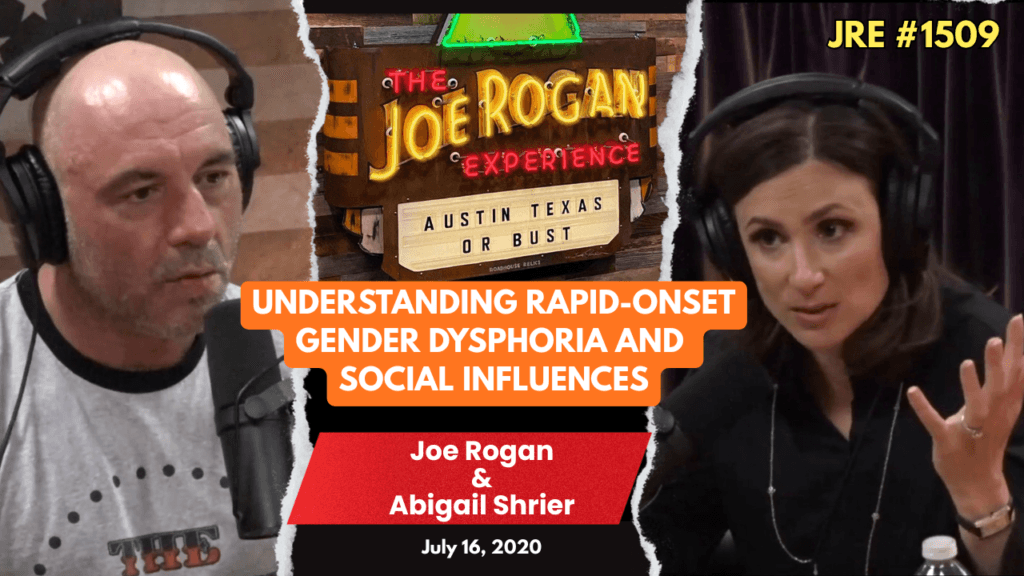
🎙️ JRE #1509 | 📅 Spotify Release Date: July 16, 2020
Image Credit: Screenshot of JRE #1509
In this episode of the JRE #1509, author Abigail Shrier discusses her research into a sudden surge of gender dysphoria among teenage girls, a demographic she argues was previously unaffected by the condition. She differentiates between long-term transgender adults, whom she supports, and adolescents she believes are influenced by social media and peer groups.
Shrier characterises this trend as a social contagion driven by online influencers and “affirmative care” models that bypass traditional mental health oversight. The conversation highlights concerns regarding medical interventions, such as testosterone and surgery, which Shrier claims are being accessed by minors without adequate scrutiny.
Ultimately, she warns that this phenomenon causes irreparable physical damage to vulnerable young women who may later regret their decisions.
Adolescent Girls and the Rise in Gender Transition
Ms. Shrier argues that the surge in teenage girls identifying as transgender may be driven less by innate gender dysphoria and more by social contagion, peer clustering, and underlying mental health struggles such as anxiety and isolation. Referencing research by Lisa Littman, she contends that cases often appear within friend groups rather than randomly, challenging the view that increased acceptance alone explains the trend.
She also raises concerns about rising teen suicide rates and the broader mental health crisis, suggesting social media may play a significant role.
Social Media, Transition, and the Debate Over Teenage Girls’ Mental Health
The speakers suggest that rising anxiety and depression among teenage girls—linked to social media and discussed in The Coddling of the American Mind by Jonathan Haidt—may be contributing to more girls identifying as transgender. Citing research by Lisa Littman and accounts from parents and detransitioners, they argue that medical transition may not address underlying mental health issues and could lead to irreversible decisions made through self-diagnosis and informed consent models, including care from providers like Planned Parenthood. They question whether framing the issue primarily as a civil rights matter limits critical examination, while raising concerns about long-term psychological and physical effects on vulnerable teens.
Validation Culture and the Influence of Online Affirmation
Ms. Shrier explores how social media validation and public celebration may encourage vulnerable teenage girls to adopt identities that offer praise and a sense of belonging. She suggests that likes, supportive comments, and online communities can create a powerful feedback loop that limits space for reflection, particularly for teens who feel isolated or insecure.
She also highlights how filtered images, celebrity culture, and constant online comparison can intensify insecurity, making some girls more susceptible to social influence and external validation.
Social Influence Shaping Adolescent Behavior
Ms. Shrier discusses the concept of “social contagion,” arguing that certain mental health struggles—such as anorexia, self-harm, and trans identification—can spread within peer groups, particularly among teenage girls whom she describes as highly empathetic and prone to absorbing their friends’ distress. She contrasts this with boys, who she suggests are more likely to externalize struggles through activity or competition rather than emotional mirroring.
Her broader point is that adolescent behavior, both positive and negative, is often strongly shaped by peer reinforcement, social acceptance, and group dynamics.
Online Discourse, Teen Vulnerability, and the Influence of Influencers
In this segment, Ms. Shrier examines how anonymous online commentary can amplify negativity, noting that adolescents often process hostile remarks from strangers much like criticism from trusted peers, making social media especially harmful. She argues that public humiliation, influencer culture, and online affirmation loops can deepen teen mental health struggles, particularly among girls.
She also expresses concern about transgender influencers promoting testosterone as a remedy for distress, pointing to its short-term mood effects while warning of potential long-term medical risks and contrasting this trend with the historically early-childhood presentation of gender dysphoria.
Early Gender Dysphoria vs. Socially Influenced Identity
Ms. Shrier discusses the distinction between children with longstanding gender dysphoria and teenagers who may be influenced by peers or social trends. She argues that historically, gender dysphoria most often appeared in early childhood—frequently in boys—and that many of these children eventually desisted, sometimes later identifying as gay adults.
She raises concerns about adolescents making life-altering medical decisions under informed consent frameworks associated with organizations such as the World Professional Association for Transgender Health, questioning whether teens are developmentally equipped to choose interventions with uncertain long-term effects.
Children, Hormone Blockers, and the Affirmative Care Debate
Ms. Shrier debates the practice of medical transition for minors, questioning whether children and teenagers are equipped to make irreversible decisions about hormones and surgery without comprehensive psychological evaluation. She argues that “affirmative care,” supported by major medical bodies and influenced by organizations such as the World Professional Association for Transgender Health and the American Medical Association, prioritizes validating a young person’s self-diagnosis, sometimes through informed consent models with limited oversight.
She raises concerns about long-term effects, the impact of conversion therapy bans, and whether the rapid rise in adolescent transitions—particularly among teenage girls—reflects improved recognition or a broader social and medical shift across Western countries.
A Sudden Surge: What’s Behind the Rise in Teen Trans Identification?
Ms. Shrier notes a sharp rise in transgender identification among high school students, particularly teenage girls, from historically rare levels (around 0.01% of the population) to about 2% of U.S. high schoolers. She cites data from the UK showing surging referrals among adolescent females and highlights challenges in U.S. tracking due to easier access to medical transitions without formal diagnoses.
She frames this as a controversial issue, pointing to potential social influences, institutional affirmation policies, and professional repercussions for clinicians questioning adolescent self-diagnosis.
Gender Identity and Female Athletics: Where Should the Line Be Drawn?
Ms. Shrier acknowledges that many transgender adults seek only to live peacefully and earn respect, yet she contends that policies allowing their inclusion in women’s sports and female-only spaces spark conflicts due to enduring biological advantages from male puberty, which can undermine athletic fairness and safety.
She points to cases like transgender athletes dominating Connecticut high school track events, MMA fighter Fallon Fox’s controversial victories, and backlash against Martina Navratilova as evidence of a larger cultural tension between gender identity affirmation and preserving sex-based categories in sports.
Activism Vs. The Rights Of Biological Women
Ms. Shrier describes how many lesbians feel increasingly marginalized, forming secretive social groups with rigorous vetting to exclude trans activists—often perceived as biological males—who seek entry into women-only spaces while asserting lesbian identities and sometimes exhibiting aggressive behaviors.
She critiques the derogatory “TERF” label for women defending female-only areas, notes a shift where earlier trans generations acknowledged their biology more openly (unlike today’s pressure to affirm “trans women are women”), and argues that social media stifles dissent through suppression, career threats, and parental fears over children’s transitions—while transgender medicine advances amid celebration rather than rigorous scrutiny.
Parents, Puberty Blockers, and the Debate Over Informed Consent
Ms. Shrier observes that parents pursuing medical transitions for their children often act out of love and fear, swayed by professionals who warn of dire mental health outcomes like suicide without prompt affirmation. She raises alarms that many lack full awareness of long-term risks from puberty blockers and cross-sex hormones, such as impaired sexual development, bone density loss, and infertility.
Overall, she urges greater transparency on these medical risks and more caution to assess whether a child’s gender distress is truly persistent before irreversible interventions.
Erasing Female Athletic Achievements And Records
Ms. Shrier contends that permitting transgender women who underwent male puberty to compete in women’s sports compromises fairness, as enduring biological advantages in strength and performance diminish opportunities and accomplishments for female athletes. She highlights how social and institutional pressures stifle candid debate on these issues, with critics encountering severe backlash for challenging prevailing norms.
She portrays this as a wider cultural tension between inclusion efforts and safeguarding sex-based protections, such as those enshrined in Title IX
Backlash, Cancel Culture, And Publishing Challenges
Ms. Shrier reflects on the intense backlash she has endured for her book, yet insists it chronicles a genuine and pressing mental health crisis among teenage girls that would have emerged publicly regardless of the messenger. She highlights how distressed parents frequently reach out to her for advice, voicing regret and bewilderment over hasty medical choices driven by social and professional pressures.
Framing youth gender transitions as akin to social contagion patterns seen in past phenomena like self-harm or suicide clusters, she advocates for enhanced psychological care and unfettered debate over suppression or stigma.
Gender Ideology In School Curriculums
Ms. Shrier argues that schools devote too little time to teaching children psychology and self-awareness, rendering them susceptible to external influences like premature exposure to gender ideology. She faults curricula in states like California for treating unproven ideas—such as “a boy’s brain in a girl’s body”—as established facts, viewing it as indoctrination amid limited parental input.
Though recognizing ongoing research into transgender brain differences, she warns these teachings may sway impressionable youth and stresses safeguarding sex-based spaces like sports where biology confers clear advantages.
Suppressing Data On Detransition And Regret
Ms. Shrier recounts how online activists sabotaged a researcher’s survey on teenage female detransitioners by coordinating false responses, complicating efforts to gauge the true prevalence of post-transition regret. She insists detransitioners’ stories merit open study and discussion, recognizing diverse dysphoria causes without dismissing genuine cases, while decrying an activist environment that equates youth transition scrutiny with hatred.
This culture, she argues, pressures children to self-identify as infallible, deploys aggressive tactics that stifle science, and ultimately damages perceptions of transgender people
Bonus Shorts
In the Shorts below:
1. Difference in Boys vs Girls
2. Social Media and Teenagers
3. Difference between Male and Female Athlete
4. Hierarchy Of Oppression
5. Martina Navratilova Getting Cancelled
6. Mob Justice In Social Media
7. Transgender Medicines Celebrated
8. Organisation Pushing Back on Male-Female Sports
9. Gender Studies Starts in Kindergarten in Californai
If you found this conversation interesting, you might enjoy exploring the ideas further in Abigail Shrier’s book below.
(This is an affiliate link, which means I may earn a small commission at no extra cost to you.)

Irreversible Damage
by Abigail Shrier
The book explores how social and cultural influences, particularly online and peer environments, are driving adolescent girls to pursue gender transition, often with long-term physical and psychological consequences, and explores concerns about medical interventions and social pressures..
As an Affiliate Associate, I earn from qualifying purchases.
Book(s) mentioned in the podcast that may be of interest:

The Coddling of the American Mind
by Greg Lukianoff and Jonathan Haidt
This book argues that overprotecting young people and promoting certain ideological trends on campuses—like excessive safetyism, emotional reasoning, and intolerance of opposing views—are undermining resilience, critical thinking, and long-term success.
As an Affiliate Associate, I earn from qualifying purchases.
About the Author:

Abigail Shrier is a Senior Fellow at the Manhattan Institute. Her national bestseller Irreversible Damage: The Transgender Craze Seducing Our Daughters (2020), was named a “Best Book” by the Economist and the Times of London.
Enjoyed this content? Help power future podcast clips (and my caffeine levels) ☕
☕ Buy Me a CoffeeEvery coffee helps keep the content coming!
Disclaimer: This content is provided for informational and entertainment purposes only. Views expressed in the embedded video or original podcast belong to the respective creators and do not necessarily reflect the views of this website. No affiliation or endorsement is implied.